

Syllatiles - Word Puzzle Game
Hitapps Games
I spent time with Syllatiles as a compact word game built around arranging syllables and solving logic-based word puzzles. It is the kind of title that looks simple when you first open it, yet asks for more than quick vocabulary recall: you need to notice possible word parts, test combinations, and recognize when a tempting answer does not fit. That makes it a pleasant choice for short thinking sessions rather than a game I would rush through.
Hitapps Games has placed it in the word category, and the basic download is free. That matters because the game is easy to try without committing money first. Its audience is also broad: the content rating is Everyone, and it runs on Android devices using version 8.0 or later. I would still treat the age label as a general suitability guide rather than a promise that every puzzle will feel equally easy for every player.
The public response is encouraging, with a 4.4 average from around 9.7 thousand ratings and more than 500 thousand installs. Those figures suggest that Syllatiles has found a real audience, but they do not remove the need to judge its style for yourself. Word games are especially personal: one player may enjoy slowly untangling a difficult arrangement, while another may find the same task fussy or repetitive.
How the puzzle format feels in everyday play
The central appeal is the relationship between small word pieces and complete answers. Instead of simply selecting a definition or guessing a hidden word from a fixed number of letters, I found myself looking at the available syllables as movable clues. The useful habit is to scan for familiar beginnings and endings first, then consider whether the remaining pieces can form a natural word. This turns each round into a small process of elimination.
That structure gives the game a different rhythm from a conventional crossword. A crossword usually gives you a clue and a grid, while a standard anagram game tends to focus on rearranging letters. Syllatiles sits between those ideas: the pieces carry sound and spelling information, but the solution still depends on recognizing a meaningful word. For me, that made the puzzles feel more approachable than a large crossword while offering more thought than a simple daily word guess.
Related News

Threads in Real Life: Who Should Join, Lurk, or Leave

How SHEIN Turned Shopping Into an Endless Content Feed

How to Make Fortnite Feel Smarter on Mobile

Should You Switch to Microsoft Outlook on Mobile?

Why Gallery Keeps Pulling Users Back

X Review: Why Its Network Still Matters
I also like that syllables encourage players to think in chunks. When I get stuck on individual letters, I often start making random combinations. Working with larger word parts discourages that habit. I can ask whether a piece sounds like a likely prefix, whether another belongs at the end, and whether the completed result is something I would actually say. That is a small but useful change in solving technique.
A practical way to play is to avoid locking onto the first plausible answer. I check the whole set of pieces before committing, because an answer can look convincing while leaving an awkward fragment behind. The strongest solution is usually the one that uses everything cleanly and sounds like a genuine word. This is one of the more valuable lessons the game quietly teaches: completion is not enough; the arrangement has to make sense as a whole.
A good fit for short breaks
I would use this game during a commute, while waiting for an appointment, or in the few minutes before bed. It does not require the same uninterrupted attention as a long-form puzzle game, and a single challenge can provide a focused mental reset. The format is also suitable for players who enjoy language but do not want to carry a notebook of clues or remember a complicated rule set.
Gallery
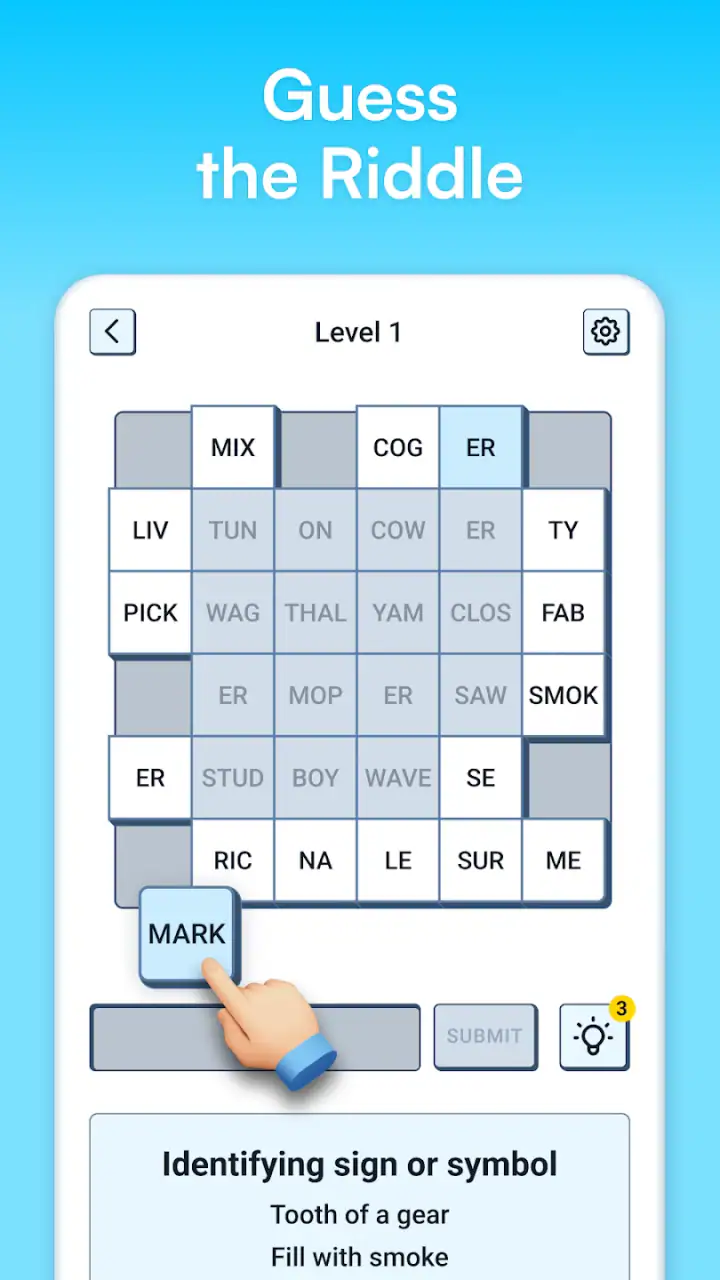
There is a difference between a short session and a rushed session, though. If I try to solve everything as quickly as possible, the word-building aspect becomes less enjoyable. The better experience comes from giving each arrangement a moment of inspection. I read the pieces mentally, try a few likely orders, and only then decide whether I need another approach. That slower method makes the game feel more like reasoning than tapping.
It can also work as a shared activity. One person can suggest a possible beginning while another tests the ending, which is more engaging than taking turns on a basic word-search grid. I would not describe it as a full multiplayer experience, but the puzzles are easy to show someone nearby and discuss without needing a long explanation.
What the free starting point means
The game is listed as free, so a new player can begin without paying an entry fee. That is the most important value fact for anyone deciding whether to install it: you can judge the puzzle style directly instead of buying based only on screenshots or a description. For casual players, free access may be all that is needed if the available play time already feels satisfying.
There are in-app purchases ranging from $2.49 to $79.99 per item. I would therefore approach the purchase screen carefully and decide what the free experience is worth to me before spending anything. The wide range means that a small optional purchase and a much larger one are both possible, so the sensible comparison is not simply “free versus paid.” It is whether a particular purchase improves your personal routine enough to justify its cost.
I would not assume that paying automatically makes the puzzles better. The value comes from how much use you get from the game and how comfortable you are with its purchase options. Someone who plays occasionally may prefer to keep it as a no-cost diversion. A frequent player may see more reason to pay, but only after confirming which paid item is being offered and whether it addresses a real annoyance rather than an impulse.
That distinction is especially important for families. Because the age rating is Everyone, a parent may consider it suitable for a broad range of players, but I would still keep an eye on purchases if a shared device is involved. The practical question is not whether the game is expensive by default; it is whether the device settings and household rules prevent an accidental selection from becoming a surprise charge.
Where the design earns its keep
The strongest value is the focused mental activity. Syllatiles gives me something specific to solve, yet the rules are light enough that I can return after a break without relearning a system. That makes it more convenient than many larger word games, especially when I want a puzzle that starts immediately and does not demand a long campaign.
Another strength is the way it rewards vocabulary awareness without requiring a dictionary-style approach. I do not need to memorize obscure definitions to appreciate the core challenge. I mainly need to recognize how word parts can fit together and remain willing to revise a guess. Players who enjoy language patterns, spelling, and small logic problems will likely get more from it than players who want action or visual progression.
The game also has a useful middle ground in difficulty. It is not merely a test of speed, but it does not feel like an academic exercise either. When I solve a tricky arrangement, the satisfaction comes from spotting the structure rather than from tapping rapidly. That makes it a better match for a reflective player than for someone searching for constant stimulation.
Still, the value is tied closely to tolerance for repetition. The basic pleasure comes from solving one word arrangement after another. If you need a large variety of mechanics, story content, or competitive systems to stay interested, this focused format may feel narrow. I see that as a trade-off rather than a flaw: concentration is the point, but concentration on one idea can eventually become predictable.
Small techniques that make harder rounds fairer
My first useful technique is to separate recognition from placement. I look for pieces that could begin a word, pieces that clearly sound like endings, and fragments that seem flexible. I then build from the most distinctive part rather than moving everything at random. This reduces wasted attempts and makes a difficult puzzle feel more manageable.
A second technique is to say possible combinations aloud, even quietly. Syllables are sound-based pieces, so hearing an arrangement can reveal an unnatural sequence faster than staring at it. This is particularly helpful when two visual orders look similar. The spoken rhythm often tells me whether I am close to a real word or merely forcing letters into place.
My third tip is to treat an almost-correct answer as evidence, not failure. If a combination leaves one piece that does not belong, I keep the useful part in mind and change only the uncertain section. That approach is more efficient than clearing the entire attempt and starting again. It also makes the logic element clearer: each unsuccessful arrangement can narrow the possibilities.
Finally, I would stop briefly when I begin repeating the same guess. A short reset is more useful than pressing through frustration. After looking away, I often notice that a piece I treated as a suffix could work at the beginning, or that I overlooked a familiar word because I was reading the fragments too literally. This is a simple workflow, but it suits the game’s arrangement-based design particularly well.
Trade-offs compared with other word games
Compared with crosswords, Syllatiles is less dependent on broad general knowledge and clue interpretation. That can make it friendlier for a quick session, but it also means players who love layered clues and a large grid may miss that depth. A crossword gives you several intersecting routes into a puzzle; this game keeps the focus on the pieces in front of you.
Compared with letter anagrams, it offers a more natural linguistic structure. Rearranging syllables can point toward pronunciation and word shape, while loose letters can produce a much larger and sometimes more chaotic search space. The trade-off is that players who enjoy generating many possible words from the same letters may find the syllable approach more constrained.
Compared with a daily guessing game, it is less about maintaining a routine around one headline challenge and more about solving a sequence of compact arrangements. That makes it useful when I want multiple short puzzles, but less compelling if my favorite part of a word game is sharing one result with friends each day. It also lacks the social ritual that often keeps daily titles in a player’s habits.
Compared with word-search games, the challenge here feels more deliberate. A word search rewards visual scanning across a field of letters, whereas Syllatiles asks me to reason about order and word construction. If you enjoy finding hidden shapes quickly, a word-search title may suit you better. If you prefer asking “what can these parts become?” this game has the stronger appeal.
Who is likely to get the most value
I would recommend it to language learners who enjoy practicing word structure in a low-pressure way, although I would not treat it as a complete learning course. It can encourage attention to prefixes, endings, and pronunciation-like chunks, but enjoyment still depends on recognizing the words used by the puzzles. Someone building vocabulary may find it useful as a supplement, not as a replacement for deliberate study.
It is also a good match for adults who want a calm alternative to reflex-based mobile games. The Everyone rating makes it broadly accessible, and the straightforward premise means a relative or friend can understand the activity quickly. For a household looking for a light shared puzzle, the ability to discuss possible arrangements is more valuable than flashy presentation.
People who prefer games with a clear story, character development, or strategic resource management should probably skip it. Syllatiles is not trying to provide those layers. Likewise, players who need constant novelty may lose interest because the core loop remains centered on word assembly. I would choose a richer puzzle collection instead if I wanted several distinct mechanics in one app.
I would also hesitate to recommend it to someone who dislikes trial and error. Even with a logical approach, there will be moments when more than one arrangement seems possible until the full word becomes clear. That uncertainty is part of the appeal for me, but it can feel irritating if you want every answer to follow an obvious clue.
Device fit and practical expectations
The minimum operating-system requirement is Android 8.0, so owners of older devices should check compatibility before planning to use it. On a supported phone, the concept is naturally suited to touch interaction because the central task involves handling word pieces. I find that preferable to a game that tries to squeeze a large keyboard or a dense crossword grid onto a small screen.
The current version is 2.0.0. I would keep the app updated through the normal store process, particularly if I play regularly, but I would not use the version number alone as a reason to expect a specific feature set. What matters in practice is whether the current build runs comfortably on your device and whether the available puzzle flow matches the amount of variety you want.
The developer, Hitapps Games, has made a focused game rather than an overloaded utility. That focus helps the first session: I can understand the purpose quickly and begin solving without studying a manual. The same focus creates the main limitation, because players looking for a broad suite of word modes will find fewer reasons to switch between activities.
My buy-or-skip judgement
I would install Syllatiles if I wanted a free word puzzle for short, thoughtful sessions and liked the idea of assembling words from syllable-sized pieces. The no-cost starting point lowers the risk, and the game delivers a distinct style compared with ordinary crosswords, anagrams, and word searches. My recommendation is strongest for players who enjoy language patterns and do not mind pausing to reason through a stubborn arrangement.
I would keep my spending measured. Since purchases can range from $2.49 to $79.99 per item, I would play first, identify whether the free access already satisfies me, and only then consider a paid option. I would not buy simply because I had been stuck on a puzzle or wanted to progress faster. The purchase is worthwhile only when it supports a habit I already enjoy.
For me, the final decision is a clear try, with a cautious approach to optional spending. It is not the right choice for action fans, story seekers, or players who need a constantly changing set of mechanics. But as a compact word game from Hitapps Games, it offers a pleasant form of focused problem-solving, and its best moments come when a few ordinary-looking pieces suddenly click into one convincing word.
My verdict: download it for free if you enjoy calm word logic, test the full rhythm before paying, and skip it if repeated syllable arrangements sound more like work than play.
FAQs for Syllatiles - Word Puzzle Game
What is Syllatiles - Word Puzzle Game?
Syllatiles is a word puzzle game built around combining syllables to form complete words. Instead of simply arranging individual letters, you work with tile groups that represent parts of words, making each level feel different from a traditional crossword or anagram game. It is designed for players who enjoy vocabulary challenges, pattern recognition, and relaxed brain-training sessions on mobile devices.
How do you play Syllatiles?
The basic gameplay involves examining the available syllable tiles and arranging or connecting them to create valid words. As you progress, puzzles can become more challenging by introducing less obvious combinations, longer words, or limited options. The game rewards careful observation and vocabulary knowledge, so taking time to test possible arrangements is often more useful than making random moves.
Is Syllatiles suitable for beginners and children?
Syllatiles can be approachable for beginners because its central mechanic is easy to understand: combine syllables into words. However, the difficulty may increase as the levels advance, and some puzzles could require a broader vocabulary or familiarity with less common word structures. Parents should still check the store listing and device settings for age guidance, language availability, and advertising information before allowing children to play.
Can Syllatiles be played offline?
Whether every feature works without an internet connection may depend on the version installed and the platform you use. Core puzzle gameplay may be available offline, which is convenient for travel or areas with unreliable connectivity, but features such as advertisements, purchases, cloud synchronization, updates, or analytics can require internet access. It is best to test the game once after installation before relying on it offline.
Is Syllatiles free to download, and does it include ads or in-app purchases?
Syllatiles may be offered as a free download, but the exact monetization model can vary between Android and iOS versions and may change after updates. Free versions commonly support development through advertisements and may provide optional purchases, such as removing ads, unlocking content, or obtaining hints. Review the current store page before downloading to confirm pricing, permissions, subscription details, and available purchase options.
Pros
- Simple tile-based gameplay is easy to learn within a few minutes.
- Short rounds make it convenient for quick breaks or daily play.
- Word-building challenges help exercise spelling and vocabulary skills.
- Clean visuals keep the board readable on smaller phone screens.
- Gradually harder puzzles provide a satisfying sense of progression.
Cons
- Some puzzles may feel repetitive after extended play sessions.
- A limited vocabulary can make certain solutions difficult to recognize.
- Hints may reduce the challenge for players seeking a pure word test.
- Progress can feel slow if later levels require repeated attempts.
- The game may be less appealing to users who prefer fast-paced action.


